









|
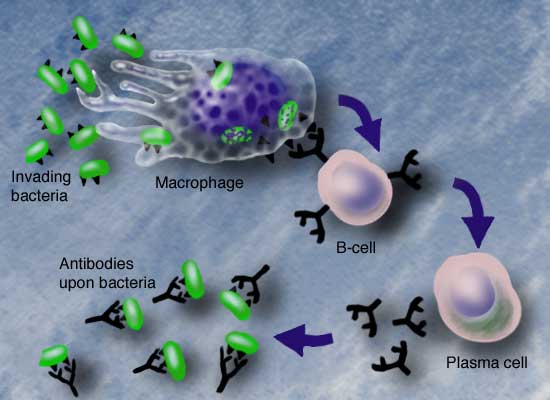
T-Cell Versus B-Cell Immune response![]() T-cell Response - Invading bacteria are phagocytosed (taken into the body of the macrophage). The macrophage then removes the specifics identifying markers, or antigens, of the invading bacteria. It places these antigens on its own surface. Helper T-call lymphocytes which are specially designed to fight this invading bacteria have on their own surface a complementary antigen marker, much like a puzzle piece. When these specialty T-cell lymphocytes notice a macrophage presenting the complement antigen they initiate a response which results in B-cell proliferation. T-cell Caption summary: When a virus invades the body it is engulfed by a macrophage cell. The macrophage then signals T-cells to cause B-cells to multiply. ![]() B-cell (antibody) Response - Through a process called phagocytosis, immune cells called macrophages will engulf invading bacteria. The macrophage will then remove the identifying markers, or antigens, from the invading bacteria and present them on its own surface. B-cell lymphocytes will notice that the antigens have been presented on the macrophage and will begin to secrete large quantities of antibodies. These antibodies bind to the invading bacteria, which will then become ineffective and more easily destroyed by macrophages. B-cell caption summary: When a virus invades the body it is engulfed by a macrophage cell. Markers on the surface of the macrophage signal the B-cell to produce antibodies which disable the invading bacteria. © Laura Maaske, 2000 |